
Psychodynamics and Inner Workings of the Enneagram Types
What Sigmund Freud's Structural Model reveals about the Lines of the Enneagram


We, as human beings and therefore our personalities, are not static at all. Our personalities are moving patterns that are shifting with our moods, relationships, and circumstances. The Enneagram captures this dynamism. Its lines are not decorative geometry, but map out how our psyche compensates, defends, and - at its best - evolves.
Traditionally, these lines were called the Path of Integration and Path of Disintegration respectively which created the assumption that one line represents “something good”, while the other represents “something bad”.
This dualistic framing persisted partly because early Enneagram teachers emphasized behavior over underlying psychodynamics. But the lines were never meant to judge our movements. They describe psychological and energetic shifts within the psyche.
Each line in the Enneagram carries two directions, and each direction can express itself on two levels of consciousness: egoic (compensatory/adaptive) and essential (growth/integration). This gives us four “moves” per type. For this article I’m going to focus on the egoic movements. The subtle direction of deterioration our psyche takes when we drift along unconsciously.
Each Type can move away from his point on the Enneagram toward two other Types. One of them is the so called Defensive Point. It resembles the reactive movement of the psyche under pressure. The personality borrows traits from the other type to maintain its defenses or reassert control. It is therefore compensatory and unconscious.
In the other direction lies the Security Point. The movement the psyche takes when it feels safe enough to relax its usual strategies. It can appear “positive,” but is still egoic: the personality is experimenting with expansion, not yet transformation. It is therefore conditionally adaptive and equally unconscious.
Both the Defensive Point and the Security Point resemble the psyches way to prevent falling into the more unhealthy expressions of our type. You can pretty much imagine them like failsafe mechanisms that kick in to prevent engaging in more neurotic and therefore “unhealthy” patterns of behaviour.
Ultimately they are yet another “ace up the sleeve” of the psyche, trying to make our needs met. But since these moves are unconscious and compulsive, because they are rooted in the fixated state of our personality, they are not really helpful. In terms of personal growth, they can actually become important warning signs, informing us that we are “off-track” so to speak, before things might become worse in the long run.
The other two moves, indicating growth and integration are equally important because they lay out how we behave when we are actually psychologically and spiritually healing. But to keep the already long article from becoming unbearably huge, I’ll split the information about The Missing Piece and The Soul Child of for another article.
Before we dig deeper into the lines and their meanings for each Type though, let’s familiarize ourselves with one more concept.
Freud’s Iceberg and Structural Model
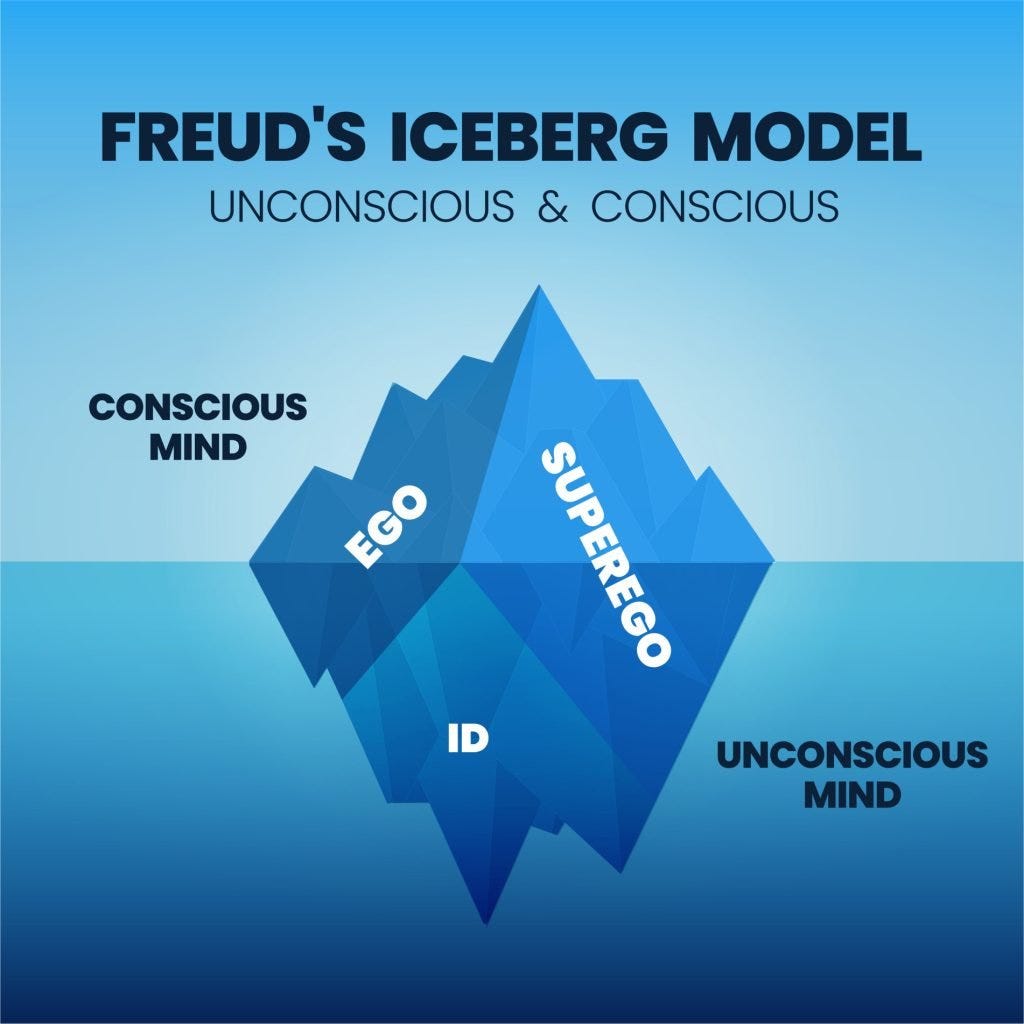
The Enneagram’s genius lies in showing movement and compensation, but it doesn’t elaborate in detail why those movements take the forms they do. Freud’s model helps us see that each Type’s line patterns express inner negotiations between instinct (Id), conscience (Superego), and mediation (Ego).
Id: The instinct-driven, pleasure-seeking part of our mind, responsible for raw instinctual impulses and affect. It is focused on immediate gratification and represents the largest part of our unconscious.
Ego: The rational mediator that balances the Id’s impulses and the Superego’s demands with real-world constraints. It manages (self-)image and identity formation.
Superego: The moral conscience representing societal and parental standards. The guiding force behind our striving for “ideal” behavior.
Taking a closer look at the Enneagram Triads and the nine Types through the lens of Freud’s structural model can reveal astonishing insights. It allows us to understand for example, why the Lines between the Types are set up the way they are and why the Enneagram as a whole is a universal symbol that encapsulates our shared humanity.
If we remember the fourfold dynamic that the lines represent, we can realize that they mirror the tension and movement between Id, Ego, and Superego beautifully:
The Defensive Point is a reactive compensation when the Ego is under siege by the Id or Superego.
The Security Point is a reactive adaptation in which the Ego is expanding its repertoire, experimenting with different functions but still maintaining its core identity.
The Lines and Psychodynamics

Each of the nine Enneagram types represents a distinct configuration and imbalance of the Id, Ego, and Superego. The three Enneagram Triads reflect a central problem related to one of these psychic functions. Within each triad, the dominant function of the individual type comes into conflict with the triad’s core issue, while a third function remains largely repressed. The dynamic interplay of dominance, conflict, and repression defines the particular flavor of each personality type’s inner struggle.
In the Instinctive (Gut) Triad the psyche is dominated by the Id, the reservoir of instinctual drives and primal energy. The core problem of this triad revolves around anger and the regulation of instinctual force:
For the Eight, the Ego over-identifies with instinct, leading to excessive assertion and defiance.
For the Nine, the conscience disengages from instinct, resulting in inertia and loss of vitality.
For the One, the Superego suppresses instinct, producing resentment and rigidity.
In the Feeling (Heart) Triad the psyche is organized around the Ego, preoccupied with maintaining a cohesive and admirable self-image. The central issue here concerns identity and self-worth:
For the Two, Superego guilt conflicts with the Ego’s need to be loved, leading to manipulative self-sacrifice.
For the Three, Ego dominance represses the Id, so image replaces identity and achievement substitutes for inherent value.
For the Four, the Ego and Id collide, creating emotional intensity and oscillation between self-inflation and self-rejection.
In the Thinking (Head) Triad the psyche is dominated by the Superego, which governs authority and security. The central issue is anxiety and the search for reliable guidance:
For the Five, a weak Ego fails to mediate between Id and Superego, leading to withdrawal and detachment.
For the Six, an overdeveloped Superego internalizes a whole committee of authorities, generating fear and ambivalence.
For the Seven, the Ego evades Superego restrictions, resulting in impulsivity and compulsive avoidance of limitation.
Psychological growth, when it occurs, involves bringing the repressed function into conscious awareness, allowing the psyche to regain balance and flexibility. Disintegration, by contrast, happens when the dominant function tightens its control in an attempt to restore equilibrium. The result is a collapse of mediation: the Ego either fuses with the Superego or succumbs to the Id, amplifying anxiety, compulsion, and the loss of authentic agency.
We will now take a closer look at each type to see how these inner tensions shape the specific personality structures and the characteristic movements of egoic deterioration along the lines of the Enneagram.
Depths of the Heart (Feeling Triad)

The Heart Triad, consisting of Types Two, Three, and Four, orbits around the central question of identity and worth. Here, the Ego seeks stability not through control or certainty, but through relation: “Who am I, if not seen, valued, or loved?”
Psychodynamically, this triad expresses the Ego’s struggle to mediate between the raw emotional needs of the Id - to be held, to be special, to be loved - and the Superego’s ideals of how one should appear to deserve that love. The result is an identity built as much from reflection as from essence: the self becomes a performance of worth rather than its living expression.
Each type in this triad distorts love in its own way. The Two attempts to earn it through selfless giving, the Three through success and image, and the Four through the cultivation of uniqueness and depth. Yet beneath these strategies lies a common wound, the heartbreak of conditional self-worth.
To return to the truth of the heart, the Ego must relax its performance and allow itself to feel without curation. Only then can love reveal itself not as something achieved or reflected, but as the natural radiance of being itself.
Type Two
Core Psychodynamic Structure
Type Two’s personality is organized around the Superego’s directive to be loving, helpful, and selfless. The Ego of the Two builds its entire sense of self around this conditional worth, forming an image of the benevolent, indispensable giver. In turn, it represses the Id’s natural self-centered impulses - desire, aggression, and the need to receive - because these threaten the self-image of “selfless love.”
This inner conflict between the Id’s natural needs and the Superego’s demand for altruism creates a profound dependency: the Two must secure love through service. Their warmth and generosity often masks a deeper hunger: “If I give enough, maybe I’ll be loved in return.”
In Freudian terms, the Ego serves as a mediator that over-identifies with the Superego’s ideal, while secretly bargaining with the Id for recognition. The result is emotional inflation and subtle manipulation, all in service of holding the fear that their own needs are too much, or not enough to inspire love freely at bay.
The tragedy of this structure is that in denying their own needs, Twos perpetuate the very lack they’re trying to heal. Their love becomes conditional because it’s never truly self-sourced.
The Defensive Point: Move to Type Eight
When the Two’s efforts to win appreciation fail or their hidden dependency is exposed, the psyche flips. The Two’s repressed assertive drives surge forward: anger, willpower, and control - in an attempt to regain power and protect the wounded self.
The outward warmth cools into intensity: “After all I’ve done, how could you?” What once appeared as generosity becomes accusation; seduction turns to domination. The Two insists on independence while secretly demanding loyalty, punishing others for not meeting the unspoken emotional contract.
This is a defensive compensation: the psyche defends against humiliation and helplessness by asserting strength. The heart hardens to prevent the deeper pain of rejection.
Early warning signal: emotional giving turns possessive or coercive; the wish to be needed morphs into anger when others fail to reciprocate. If unattended, this marks the beginning of the Types disintegration toward its unhealthy expression.
The Security Point: Move to Type Four
When the Two feels safely connected or accepted by others, the Ego relaxes its usual strategy of compulsive giving and “moves to Four.” The persona of warmth and helpfulness softens, and deeper emotions of loneliness, longing, and unmet needs begin to surface.
At first glance, this seems like emotional honesty. The Two finally admitting their own needs. But the movement remains egoic: instead of true vulnerability, the Two often performs their suffering. They may become temperamental, moody, or self-absorbed, using emotion as a way to reestablish connection or sympathy.
The focus shifts from caring for others to ensuring that others see their pain. Their generosity turns inward, yet still functions as a strategy to secure love and validation.
Early warning signal: when emotional openness becomes dramatization or self-pity, when “I feel hurt” subtly turns into “no one appreciates me”, it’s a sign the psyche is looping through familiar defenses rather than truly integrating the underlying need.
Integration Focus
Both movements, toward Eight under strain and toward Four in safety, trace the Two’s central tension between giving to be loved and loving oneself. Awareness of these patterns helps the Two recognize when their heart closes in pride or dramatizes in longing. Notice patterns of patronizing others, being overly intrusive or engaging in people-pleasing. By noticing these shifts early they can return to genuine contact, where giving and receiving are no longer negotiations for love, but natural expressions of it.
Type Three
Core Psychodynamic Structure
Type Threes psyche is organized around the Ego - the psychological function that mediates between impulse and conscience. For the Three, however, this mediating function becomes identity itself.
The psyche builds its sense of self entirely on the Ego’s capacity to for achievement, recognition, and success. Threes internal world revolves around maintaining a coherent, admirable self-image. The Ego identifies so completely with this image that authentic feeling and spontaneous being are sacrificed in service of performance.
This identification creates a deep alienation from the heart, the realm of genuine feeling and connection. Emotions are unconsciously repressed because they slow down performance or threaten the polished image. At its root, this structure forms as a defense against the early fear that love depends on achievement.
The Id’s instinctual spontaneity is repressed as “unproductive,” and the Superego’s moral voice is internalized mainly as the demand to succeed. The result is an identity built on doing rather than being: efficient, adaptive, and dazzlingly competent, but emotionally disconnected. The result is a split between the self as experienced and the self as presented.
As always with the primary types, the tragedy of this structure is universal: in striving to be someone, the Three loses touch with the being they already are.
The Defensive Point: Move to Type Nine
When the Three’s performance falters, pressure gets too high or external validation dries up, the psyche “moves to Nine.” The inflated, goal-driven Ego deflates into passivity and disengagement. This is not true rest, but a form of energetic collapse. The Ego withdrawing from the pain of failure or exposure.
The once-driven personality becomes diffuse: indecision replaces focus, and the Three distracts themselves with comfort or mindless activity. The inner narrative shifts from “I must succeed” to “It doesn’t matter anyway.” This resignation keeps the deeper feelings of shame, inadequacy, and loss of identity out of awareness.
Early warning signal: productivity gives way to avoidance; enthusiasm becomes inertia. The spark fades from a further disconnection from one’s emotional core.
The Security Point: Move to Type Six
When the Three feels safely supported or part of a trusted group, the Ego relaxes its relentless self-promotion and “moves to Six.” The confident, forward-driving persona begins to show cracks, and the Three starts to express self-doubt, pessimism, and anxiety.
This movement can be constructive because it opens the door to greater emotional honesty and connection. The Three allows the façade to loosen just enough for their inner worries and insecurities to surface. Yet, it remains an egoic process if this connection with others merely serves as a place to unload accumulated frustration, complaints, and fears - a temporary discharge rather than genuine vulnerability.
At this stage, the Three is not yet really feeling their emotions but managing them through others. The impulse to maintain control is still present, only redirected toward relational dynamics instead of image maintenance.
Early warning signal: when self-doubt turns into chronic complaining or dependency on reassurance, it’s a sign that the Ego is using connection to stabilize itself. Not as a bridge to authenticity, but as another coping mechanism in disguise.
Integration Focus
Type Three’s growth depends on noticing when their drive to achieve starts to overshadow their capacity to simply be themselves. Both movements, the collapse into Nine and the adaptation toward Six, reveal the same underlying truth: the false self cannot sustain connection.
When the Three notices these shifts early, they can use them as invitations to pause performance and reinhabit their emotional life. The task is not to stop achieving, but to remember who is achieving: the living, feeling person beneath the image.
As the identification with image softens, authenticity and presence return. The heart, once trained to seek applause, rediscovers a quieter rhythm — where worth is not earned, but experienced.
Type Four
Core Psychodynamic Structure
Type Fours are intensely self-aware and emotionally complex because their ego structure is highly attuned to affect and identity. “Who am I, and how do I express what I feel?” The Ego here is preoccupied with authenticity, yet paradoxically tries to curate that authenticity. It acts as both artist and censor, shaping raw impulses from the Id into meaningful self-expression.
The problem is that the Id’s raw material feels too primitive or shameful for the Four’s aestheticized self-image. Thus, they oscillate between overidentification with emotion (being consumed by mood) and suppression of instinctual vitality (self-withdrawal and melancholy).
While this grants the Four a deep sensitivity to nuance, it also traps them in self-reference. The inner world becomes an echo chamber of comparison, longing and frustration. All in the service of reasserting the self’s specialness.
The tragedy of this structure is that the compulsive search for authenticity distances the Four from the natural, uncontrived authentic identity they long for.
The Defensive Point — Move to Type Two
When the Four’s emotional intensity threatens to overwhelm them, the psyche “moves to Two.” The Ego compensates for inner emptiness by turning outward, seeking connection through helpfulness, attention, or seduction.
This move often looks like generosity, but it’s a subtle inversion: the Four gives in order to be seen. They attempt to evoke the love they long for by making themselves indispensable or emotionally magnetic. Beneath the caring exterior, however, lies a quiet agenda to confirm their worth through another’s response.
Psychodynamically, the Ego is defending against feelings of abandonment by over-functioning relationally. The emotional depth remains, but it is now directed toward managing and manipulating connection rather than inhabiting it.
Early warning signal: when helping becomes strategic or when emotional giving masks a hidden hope of being rescued in return, it’s a sign that longing has overtaken genuine contact.
The Adaptive Point — Move to Type One
When the Four feels safely contained, either within a trusted relationship or a stabilizing structure, the psyche relaxes its emotional turbulence and “moves to One.” The Ego seeks order after the chaos of longing.
However, this movement remains egoic. The Four borrows the One’s discipline and moral clarity, but uses it to fortify identity rather than transcend it. What was once emotional intensity now condenses into judgment and criticism.
The Four becomes exacting, toward themselves and others, believing they alone perceive what is right, beautiful, or authentic. Their inner critic sharpens, externalized into a scolding attitude or a fussy perfectionism. The raw dissatisfaction and frustration that were once diffused in heightened feelings now take form as irritation with imperfection.
Empathy narrows. Others are measured against the Four’s refined internal ideal, and rarely meet the mark. What masquerades as “high standards” is often the Ego’s attempt to control the pain of disillusionment. To turn longing into righteousness, and vulnerability into superiority.
Integration Focus
For Type Four, growth begins with noticing the shift from feeling to managing feeling. Both movements, the relational Ego inflation at Two and the moral refinement at One, show the same underlying mechanism: the Ego trying to regulate emotional life to preserve identity.
When the Four recognizes these moves as signals rather than truths, space opens for direct experience. The goal is not to stop feeling intensely, but to allow emotion to pass through without needing to interpret or curate it. Fours can use their natural self-awareness to spot patterns of contempt, self-absorption and being overly involved in their own imaginations.
As the identification with emotional specialness loosens, the natural vitality of the heart reemerges: tender, responsive, and unguarded. The longing for authenticity resolves not through more depth, but through simplicity.
The Labyrinth of the Mind (Thinking Triad)

The Head Triad, consisting of Types Five, Six, and Seven, orients itself around the fundamental tension between fear and security. Where the Heart longs for authentic affect and the Body autonomy and unhindered sensation, the Mind seeks certainty through understanding.
At the core of this triad lies the psyche’s struggle with the Superego: the part that insists safety can be achieved through vigilance, preparedness, or mastery. Here, thought becomes a way to preempt the unpredictable and soothe the deep, often preverbal anxiety of existence.
The result is a split between knowing and being. The more the mind attempts to comprehend reality, the further it drifts from its immediate experience of it. In this gap, fear breeds - not just of danger, but of the vast, uncontrollable nature of life itself.
Each type in this triad seeks to manage that fear in its own way. All three strategies orbit the same illusion: that the mind can secure what only presence can reveal.
To awaken from the labyrinth, the task is not to think better thoughts, but to trust beyond thought. To recognize that safety does not arise from certainty, but from contact with reality as it is.
Type Five
Core Psychodynamic Structure
At the heart of the Five lies the fear of obligation and depletion. Of being overwhelmed, intruded upon, or consumed by the demands of life and others. The Five’s psyche is organized around defense through withdrawal.
The Ego, aligned with the Superego’s directive to “stay self-sufficient and contained” suppresses the instinctual and emotional life of the Id, which it experiences as invasive or threatening. Safety is sought not through possession or control, but through minimizing need.
Knowledge becomes the substitute for power and understanding replaces active participation. The Five’s world narrows into the mind, where observation provides the illusion of mastery without the risk of engagement. Yet this detachment, meant to preserve inner resources, often leads to the very emptiness they fear. A sterile isolation that cuts off nourishment and contact. This defensive posture is not born of coldness, but of a subtle terror: that to open would mean to be devoured.
The tragedy of this structure is that in defending their inner world so fiercely, Fives cut themselves off from the very sources of replenishment they seek. Their retreat, intended to conserve life energy, paradoxically drains it. What was meant to protect vitality becomes the architecture of fatigue and loneliness.
The Defensive Point: Move to Seven
When the Five’s withdrawal reaches its limits, when the tension between inner isolation and outer life becomes too much, the psyche “moves to Seven.” Here, the Ego seeks escape through stimulation and mental activity.
The Five borrows the Seven’s scattered curiosity and restless seeking, using fantasy, speculation, and rapid idea generation to distract from the claustrophobia of isolation. It’s a compensatory burst of movement: the mind racing outward after being turned inward for too long.
But this movement remains mental, not embodied. It’s still an avoidance of the present. The Five may fill notebooks, watch endless videos, or chase intellectual novelty, yet all in service of keeping emotional reality at bay. It is the mind’s rebellion against its own walls: frenetic, clever, but ungrounded.
The Security Point: Move to Eight
When the Five feels safe, or when their fragile boundaries are momentarily reinforced, the psyche “moves to Eight.” The Ego now experiments with power and assertion, reclaiming some of the instinctual energy it has long suppressed.
The Five’s suppressed Id surges into forcefulness, detachment hardens into defiance. What was once a quiet need for autonomy becomes an insistence on control.
They can become pushy, argumentative, or domineering - paradoxically crossing others’ boundaries while fiercely guarding their own. When challenged or contradicted, the Five’s underlying feelings of powerlessness and rejection flare into anger. Their intellect, once defensive, now becomes weaponized.
What looks like strength is the reactive stance against an old wound: the terror of being powerless in a world that demands too much.
Integration Focus
For the Five, both movements, toward Seven and toward Eight, serve as early signals that the psyche is moving out of balance. The head has taken command again, whether through flight into thought or the assertion of control.
Fives can use their natural observation skills to identity whenever they are engaging in patterns of provoking others, overly detaching themselves (especially from emotions) and retreating into their mind.
The invitation is to pause, to reconnect with the body, and to notice the fear beneath the activity or defiance. True security arises not from guarding energy but from participating in life as it unfolds. Presence, not preparation, restores vitality.
Type Six
Core Psychodynamic Structure
Type Six sits at the very center of the Head Triad and represents the primary expression of the Superego’s domination in the psyche. For Sixes, the moral and cognitive dimensions of the Superego fuse into an ever-present vigilance: a constant questioning of safety, authority, and trust.
The Superego in Six is not a quiet inner guide. It is an anxious sentinel, scanning for threat, inconsistency, or betrayal. The Ego, attempting to maintain stability, aligns with this internal authority: reasoning, second-guessing, and anticipating danger to stay in control.
Meanwhile, the Id’s raw drives of anger, desire, and confidence are suppressed or projected outward. The Six unconsciously assumes the world will act out what they themselves have disowned: aggression, deceit, or abandonment.
The result is a life lived under tension. A psyche both dependent on and mistrustful of authority, loyal yet skeptical, courageous yet fearful. The Six’s defense is thinking itself: endless mental preparation in an attempt to neutralize uncertainty.
The tragedy of this structure is that the very vigilance meant to keep them safe becomes the source of their suffering. In defending against potential danger, the Six never truly feels safe. The fortress they build for protection becomes the prison that perpetuates their fear.
The Defensive Point: Move to Three
When anxiety becomes unbearable and the internal questioning turns to paralysis, the Six’s psyche “moves to Three.” Here, the Ego seeks temporary relief through action and image.
Rather than wrestle with self-doubt, the Six adopts a persona of competence — striving to be seen as capable, efficient, and reliable. The Superego’s impossible standards find new expression in productivity and performance.
The Six may become overly focused on work, reputation, or meeting others’ expectations, mistaking approval for safety. Beneath the polished surface, the original anxiety remains but is now channeled into motion. Psychodynamically, this is the Ego fleeing the Superego’s tyranny by temporarily becoming its perfect servant.
The Security Point: Move to Nine
When the Six feels safe enough, when external pressures ease or trusted connections provide reassurance, the psyche “moves to Nine.”
Here, the hypervigilant Superego finally relaxes its grip. The overactive mind quiets, the nervous scanning slows, and a sense of relief floods the system. Yet rather than genuine peace, this can often become numbness.
The Six disengages from responsibilities and decisions. The same Ego that once overfunctioned now underfunctions. Withdrawing, becoming lethargic, and emotionally unavailable. In seeking calm, the Six drifts into indifference.
This movement is the pendulum swing of a tired mind: from overcontrol to surrender, from worry to inertia. The fear remains unprocessed; it’s simply put to sleep.
Others may experience the Six as detached or unresponsive which is a far cry from their usual alert engagement. Psychodynamically, this is the Superego collapsing under its own weight, the psyche retreating into a protective fog.
Integration Focus
For Sixes, both movements toward Three and toward Nine, are invaluable indicators of the psyche’s current state. The move to Three signals the mind’s attempt to control fear through doing; the move to Nine shows the mind’s exhaustion after doing so for too long.
In both, the essential task is the same: to become aware of the fear that underlies both restless activity and withdrawal. Sixes can rely on their innate hyper-vigilance to spot patterns of blaming others, being overly defensive or actively investing in the search for outside assurance and security.
Growth begins when the Six recognizes that safety cannot be secured, but can only be felt. And feeling, paradoxically, requires being vulnerable and embracing the uncertainty that comes with it, the very condition the Six’s Superego has long tried to prevent.
Type Seven
Core Psychodynamic Structure
Type Seven represents the psyche’s most creative defense against the Superego’s domination within the Head Triad. Unlike Sixes, who confront fear through vigilance, Sevens escape it by outpacing it. Their mind races toward pleasure, possibility, and stimulation - in essence anything that promises freedom from anxiety or limitation.
In Freudian terms, the Seven’s Ego acts as a negotiator between the Superego’s moral restrictions and the Id’s impulsive demands. But rather than resolve the conflict, the Ego splits the Superego off. The strategy becomes perpetual motion: “If I stay moving, I won’t have to feel the fear underneath.”
Their optimism and enthusiasm serve as a brilliant rationalization of this avoidance. The Superego says “Don’t be trapped.” The Id says “Chase what feels good.” The Ego complies with both by keeping things exciting, light, and under control.
Beneath this freedom-seeking lies an unacknowledged fear of deprivation, pain, and inner emptiness. Sevens unconsciously dread the quiet, because in the stillness, the suppressed fear and sorrow would catch up.
The tragedy of this structure is that the pursuit of freedom becomes its own form of bondage. In trying to escape limitation, Sevens become enslaved to the next experience, the next idea, the next escape from feeling - missing the beauty of the present moment.
The Defensive Point: Move to One
When the Seven’s juggling act of pleasure, plans, and possibilities begins to collapse, when reality intrudes with consequences, unfinished commitments, or fatigue, the psyche “moves to One.”
Here, the very energy that once fueled spontaneity turns into rigidity. The backlog of tasks and unmet obligations becomes overwhelming. The Seven’s optimistic flexibility hardens into self-criticism and impatience: “I have to fix everything I’ve neglected.”
This movement is the psyche’s compensatory swing from indulgence to control. The Ego, unable to sustain the fantasy of unlimited options, adopts the Superego’s posture of judgment and discipline.
Sevens can now become tense, demanding, and perfectionistic, compulsively trying to “get life back in order.” What was once avoidance through pleasure now becomes avoidance through productivity.
Psychodynamically, this movement reveals the pendulum between the Id and Superego: pleasure-seeking gives way to rigor. Both remain egoic and both are driven by the same fear of being trapped in suffering.
The Security Point: Move to Five
When the Seven feels safe enough to stop performing their usual optimism, the psyche “moves to Five.” Here, the hyperactive outward energy turns inward. The Seven who was once buzzing with activity now withdraws, becoming quiet, cerebral, even aloof. They may crave independence and privacy, finally insisting on their right to not engage.
This can be a welcome pause, a reclaiming of autonomy from constant external stimulation, but it often carries an undertone of detachment. The Seven retreats not because they are at peace, but because they are depleted.
Psychodynamically, this is the Ego’s attempt to restore control by shutting down emotional input. The Superego relaxes, but the cost is isolation - a pseudo-peace built on avoidance.
Integration Focus
For Sevens, both movements toward One and toward Five signal critical moments of feedback from the psyche. The move to One warns of overcompensation: the flight from chaos into rigid control. The move to Five warns of exhaustion: the withdrawal into detachment after overstimulation.
The opportunity lies in learning to pause before either swing becomes compulsive. To allow discomfort without running from it or trying to fix it. Sevens need to become aware of patterns like an excessive self-centeredness, hyperactive distraction and the compulsive need for stimulation.
When the Seven learns to stay still and present through boredom, sorrow, or difficulty, their defense transforms into a virtue: the quiet joy of being rather than the restless pursuit of more.
The Pulse of Existence (Instinctual Triad)

Beneath thought and feeling lies the pulse of existence. The raw, preverbal rhythm of life itself. The Instinctual Triad governs our most fundamental drives: survival, control, and the need for space to exist in the world. It speaks the language of the body: movement, tension, sensation - long before the mind translates anything into meaning.
Psychologically, these types orbit around the Id, the seat of primal energy and instinct. Yet for each, the relationship to this force is imbalanced. The Ego, fearing chaos or vulnerability, erects systems of control to tame what feels overwhelming. Thus the instinct, meant to root us in vitality and presence, becomes distorted and turned into anger, intensity, or inertia.
At the core of this triad lies the question: “Can I trust life itself?” When direct contact with instinct is lost, we lose our ground and are oscillating between overassertion, repression, and dissociation. The natural power of anger, meant to defend life’s boundaries, is either overused, misdirected, or denied altogether.
Spiritually, the work of the Instinctual Triad is a return to embodiment. To feel the pulse of existence without fear or control. To let the body speak its quiet truth. Beneath the defenses of will, withdrawal, or perfection lies a deeper intelligence. The body’s knowing of rightness, timing, and belonging. When instinct is reclaimed, presence ceases to be a concept. It becomes the ground of being itself.
Type Eight
Core Psychodynamic Structure
Type Eight’s psyche is anchored in a deep identification with instinctual energy. With the raw life force that asserts, protects, and takes up space. Their Ego forms around the conviction that to survive, I must be strong, in control, and never vulnerable. This creates a powerful alliance between Ego and Id: rather than repressing instinctual impulses, the Eight channels them directly into action and willpower.
In Freudian terms, the Eight’s Ego rides the Id’s currents rather than mediating them. Their power comes from instinct in service of defense, but this same alliance cuts them off from the regulating functions of the Superego and the emotional depth of the heart. The result is an existence lived in forward momentum: raw, reactive, and governed by intensity.
The Eight’s passion of Lust is not about sensual indulgence, but about the compulsion to feel alive through impact. Their psyche constantly seeks friction and challenge to reaffirm its aliveness and autonomy. Yet beneath this drive lies the unacknowledged fear of being controlled, betrayed, or rendered powerless.
The tragedy of this structure is that the very will to assert life becomes a defense against life itself. Spontaneity, tenderness, and trust feel too dangerous to allow in. The Eight’s strength hardens into armor, separating them from the intimacy and vitality they most crave.
The Defensive Point: Move to Type Five
When the outer world pushes back or overwhelms the Eight’s forceful engagement, the psyche retreats to Five - the realm of detachment and strategy. The same energy that once charged into life now pulls inward, consolidating its power.
This movement serves as a defensive recalibration. The Eight, feeling depleted or overexposed, withdraws to think, plan, and reassess. They become more private, even secretive, guarding their time and energy with suspicion. Others may sense their growing cynicism or the cooling of their usual vitality.
Psychodynamically, this marks a shift from instinct to intellect as the primary defense. The Ego, having been burned by overextension, now seeks safety in analysis and distance. Yet what appears as composure can conceal growing alienation. The Eight’s fear that the world cannot be trusted, that self-sufficiency is the only real protection, gets reinforced.
The Security Point: Move to Type Two
When Eights feel safely connected or emotionally grounded, their hardened exterior begins to soften. The psyche “moves to Two,” and the powerful instinct to control or protect transforms into a yearning to be wanted.
At this point, the Eight begins to channel their energy into caring acts: supporting others, mentoring, providing, protecting. Yet beneath this lies a deeper longing: the wish to know they are valued not just for their strength, but for their presence. Their giving becomes a way to seek reassurance that they matter.
They may now over-invest themselves in “doing good things” for others, hoping unconsciously that devotion will invite affection. In such moments, their immense tenderness, usually hidden behind the façade of toughness, can surface unexpectedly. Around children, animals, or anyone perceived as innocent, Eights often display a moving, almost disarming sentimentality.
Feelings of rejection or unmet needs for intimacy resurface, and the Eight may experience a bittersweet recognition of their own lost innocence. The tender part of themselves they once armored over in the name of survival.
Psychodynamically, this is the Ego experimenting with the heart. It’s not yet full integration, but a glimpse into the possibility that strength and vulnerability can coexist.
Conclusion
The Eight’s work lies in transforming the identification with raw instinct into conscious vitality. The Defensive movement to Five offers the insight that power without reflection burns out, while the Security movement to Two reminds them that strength without tenderness isolates.
The heart of Eight’s is strong enough to see accept the truth of their behaviour. They can use that strength to recognize when patterns of confrontational intimidation, domination of others, or pushy over-assertion show up.
When the Eight learns to temper will with awareness, to let energy flow rather than dominate, their passion refines into presence. Power becomes rooted, not reactive, and what once felt like a fight for survival opens up into a fearless participation in life itself.
Type Nine
Core Psychodynamic Structure
As the primary type in the Instinctual Triad, Nine reveals the paradox of the body disconnected from its own power. The instinctual energy that should ground them in presence and agency is instead diffused into comfort-seeking, passive resistance, and mental or emotional absorption.
Psychologically, the Nine’s Ego develops as a defense against the overwhelming intensity of the Id’s instinctual impulses. Direct expression of will, anger, or desire feels threatening, not only to others but to the fragile sense of inner peace the Nine works so hard to maintain. The result is an Ego that represses assertion and redirects instinctual vitality toward maintaining “harmony”.
Rather than channeling energy outward through clear boundaries and engagement, the Nine turns it inward to sustain a tranquil inner bubble. They replace instinctual immediacy with ruminative thinking and emotional attachment to comforting people, places, or routines. This becomes both their refuge and their prison: a quiet life of gentle disconnection.
Internally, the instinctual energy builds powerful defenses of numbing, the idealization of peace and rationalization, while externally, it shields the Nine from the demands of life. Their independence, vitality, and sense of self fade under the weight of this gentle self-erasure.
The tragedy of this structure is that in trying to avoid (inner and outer) conflict, Nines abandon their own aliveness. The very instinct that could root them in reality becomes the force that sustains their distance from it.
The Defensive Point: Move to Type Six
When the Nine’s habitual avoidance has led them into stagnation or chaos, the built-up tension finally breaks. The psyche “moves to Six,” activating the mental center that had long been subdued.
The formerly placid and accommodating Nine now becomes anxious, doubtful, and reactive. Nervous energy replaces inertia. Thoughts spiral around worst-case scenarios, and the mind grows restless with self-questioning. What was once gentle optimism now turns into pessimism and suspicion, toward others and toward life itself.
Psychodynamically, this is the instinctual system turning against itself: energy that once maintained numbness now erupts as anxiety. It’s the cost of long-denied self-assertion pressing for release.
The Security Point: Move to Type Three
When the Nine feels safely accepted or affirmed, the dormant instinctual energy briefly channels into the Three’s adaptive image of confidence and productivity. The Ego “moves to Three,” and the Nine becomes more energetic, expressive, and outwardly driven.
They may suddenly care about appearances, reputation, or achievement, investing in being seen as capable and admirable. This new self-presentation can feel like a breakthrough: a long-delayed awakening of motivation and self-importance. Yet it often remains conditional and externally oriented.
In adapting to others’ expectations, the Nine risks losing themselves even further. The once self-effacing personality may now seek attention, recognition, or validation, displaying a subtle narcissism that contrasts sharply with their usual humility. Workaholism or overcommitment can set in as they strive to “look good” and maintain connection through performance rather than authenticity.
Psychodynamically, this is the Ego’s attempt to reclaim lost agency but through imitation rather than embodiment. The Nine’s Ego now tries to act alive instead of truly being alive.
Integration Focus
At the heart of Type Nine’s journey lies the task of reclaiming their instinctual vitality. The very life force that has been muted in the pursuit of inner peace. Psychologically, the Nine’s ego structure relies on merging with others or with comforting routines to maintain stability. This creates an illusion of inner calm but comes at the cost of autonomy and presence.
The lines to Six and Three show two sides of the same struggle: one reveals what happens when anxiety replaces presence, the other when activity replaces authenticity. Together, these two movements awaken the dormant instinctual power within the Nine. Anxiety becomes awareness, activity becomes agency. The slumbering life force stirs again, not as agitation or striving, but as a steady flame.
Becoming aware of patterns of passive resignation, complacent disengagement and the avoidance of conflict are all important steps to reclaim their lost vitality.
In integration, the Nine no longer keeps the peace by disappearing. They are peace: fully embodied, awake, and engaged in the living pulse of existence.
Type One
Core Psychodynamic Structure
Type Ones psyche is dominated by the Superego, the internalized voice of “how things should be.” This moral idealism serves as a defense against the instinctual drives of the Id, which Ones unconsciously fear as chaotic, dangerous, or corrupting.
The Ego, trying to maintain control, aligns itself with the Superego to keep the Id’s impulses in check → resulting in the chronic inner tension that manifests as resentment and perfectionism.
In Freudian terms, the Ones Ego becomes the enforcer of the Superego’s prohibitions. This identification cuts them off from spontaneity, instinct, and natural pleasure but preserves their self-image as “good” and “right.”
The tragedy of this structure is that their quest for “goodness” paradoxically distances them from the natural goodness of life itself.
The Defensive Point: Move to Type Four
Similar to Threes, Ones are task-oriented and will try to keep their momentum to get things done before they attend their emotional needs. When their egoic control system becomes overstrained however, the repressed instinctual forces creep their way up. The psyche “moves to Four,” expressing the very emotional volatility it’s been repressing. This movement serves as a compensatory pressure release.
The One’s inner critic, unable to perfect the outer world, now turns inward. “I’ll never be good enough.”, “Others just don’t see all my efforts.” Though painful, this reaction is compensatory. It momentarily relieves tension but reinforces the core identification with moral failure.
Early warning signal: self-criticism becomes self-pity, ideals collapse into despair, and emotional expression serves the ego’s need for control rather than authentic feeling. If unattended, this marks the beginning of the Types disintegration toward its unhealthy expression.
The Security Point: Move to Type Seven
When the One feels sufficiently safe and accepted, the Ego/Superego combo relaxes its tight control and “moves to Seven.” The rigid self-discipline softens, and a more playful, spontaneous energy begins to emerge. Ones can become engaging, lively, and even funny, their natural joy and curiosity momentarily breaking through the moral rigidity of their Superego.
Yet, the shift is still an egoic mechanism. Having long suppressed their instinctual desires, Ones may suddenly swing to the opposite extreme. Scattering their focus, juggling too many plans, or indulging impulsively as if trying to make up for all the pleasures they’ve denied themselves. Beneath the apparent lightness is a frantic undercurrent: “I must not miss out again.”
This is not true freedom, but a rebound from repression. A temporary permission slip to enjoy life without guilt, which can easily turn into overcompensation.
Early warning signal: when enthusiasm becomes restlessness or indulgence, and joy feels like escape rather than presence, it’s a sign that the Ego is still negotiating with its own Superego, not yet trusting the simple goodness of being. Joy is permitted, rather than flowing spontaneously.
Integration Focus
Both movements, toward Four under strain and toward Seven in safety, reveal the Ones core struggle between control and acceptance. The more aware the One becomes of these shifts, the sooner they can recognize the tension behind them and pause before the pattern takes over.
Important patterns to notice are a condemning judgementalism (toward self and others), the need for rigid (self-)control and feelings of personal obligation to fix things. In this awareness, the One begins to rediscover a gentler moral compass: one that allows life and themselves to be imperfectly perfect.
Finishing Up

This lens on the Enneagram illuminates why each type is structurally distinct, why the lines connect as they do, and why the Enneagram as a whole reflects the architecture of our shared humanity.
The symbol represents each of us because the fundamental problems of being human can be understood as Id-, Ego-, and Superego-related, or, in Enneagram language, as instinctive-, feeling-, and thinking-related. Every one of us contains all three dimensions, and the balance between them is never fixed. The psyche is alive, constantly adjusting, negotiating, and transforming in response to inner and outer life.
The inner lines of the Enneagram portray this very dynamism. They mirror the movement of consciousness itself. It’s perpetual oscillation between contraction and expansion, fear and desire, effort and surrender. Everything in nature moves, only the mind wishes to stand still. Yet, as we’ve seen, even the mind’s attempts at stillness are animated by movement: by the Ego’s constant effort to hold itself together.
When we begin to see the lines not merely as “paths of stress or growth,” but as expressions of the psyche’s living motion, a deeper understanding emerges. Each movement reveals how the Ego tries to maintain equilibrium, how it compensates when unbalanced, and how awareness itself becomes the turning point.
To recognize a shift as it happens, to see our psyche in motion, is to loosen identification with it. That moment of awareness marks the beginning of real integration: a movement not of control, but of participation in the flow of life itself.
And this is where our exploration continues. In the next part of this series, we’ll look at how the same lines that trace our ego’s defenses can also guide us toward psychological and spiritual integration. Toward reclaiming what was forgotten, and remembering what was never separate to begin with.
A sincere thank you for reading this newsletter. As always, I hope to see you in the next reflection. Until then, walk with awareness my friend.
In kindness
Kevin