
The Myth of Type Compatibility
Why Awareness, and NOT Type Matching, Creates Real Connection

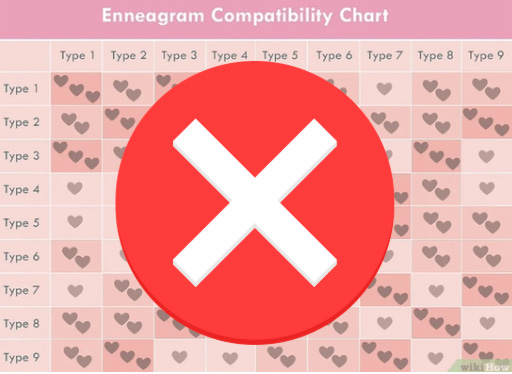
We all know the dating horoscope. MBTI compatibility calculators. They are so popular because they promise an easy, quick, and structured way to make sense of personality and interpersonal dynamics, which is particularly attractive in domains of high uncertainty - like dating.
Not surprisingly, this pop-psychology trends reached the Enneagram. Pop-Enneagram content loves to ask questions such as:
“Which type should I date?”
“Who is most compatible with me?”
“Which pairing is the best?”
These questions are tempting because they promise something we all crave: certainty. That if we simply choose the “right” type, the relationship will bypass the messy parts: the misunderstandings, the friction, the vulnerability. Compatibility becomes a shortcut, a way to avoid the unpredictable reality of loving another human being.
Yet this idea of certainty is an illusion. And a heavily limiting one.
Why the belief is limiting us
The belief in type compatibility quietly reduces us to our patterns. It reinforces the false idea that our Enneagram type defines who we are. It narrows our relational world because we gravitate only toward people who reflect our own worldview or don’t challenge it too much. It keeps us safely inside our familiar perspectives while avoiding those who might ask us to expand, stretch, or question our assumptions.
Compatibility thinking stops us from encountering people who could reveal deeper parts of ourselves, the parts that only emerge when we are asked to grow. And it blocks the tension that is necessary for genuine transformation. Ironically, the very tension we try to avoid is often precisely what’s needed for our growth.
The Enneagram does not tell us who we are, or who we should love, nor does it assign predetermined matches. It does not and cannot predict which relationships are destined to succeed or fail. What it reveals is something much more intimate: the lens through which we interpret reality, and how that lens shapes our expectations, fears, blind spots, and habitual reactions.
Two people with radically different lenses can build an extraordinary relationship if they are willing to do the work. And two people who share the exact same type can crumble under the weight of their unexamined patterns.
Compatibility is a myth. Awareness is what truly matters. Because it is awareness, not matching structures, what makes connection possible, growth sustainable, and love transformative.
What We Silently Hope For
When we’re hurt, stressed, or longing for support, most of us unconsciously expect our partner to respond the way we would respond at our best. We hope they will intuit our needs, speak our emotional language, and mirror the “high side” of ourselves. But the truth is, people seldom share the same internal logic.
Their nervous system prioritizes different things. Their attention naturally goes to different aspects of the moment. And what feels supportive or loving to them might feel confusing, insufficient, or even intrusive to us.
The Enneagram helps us understand these invisible differences. The most fundamental level of difference, are the three Centers:
The Gut Types 8, 9, and 1 seek respect, autonomy, and integrity
The Heart Types 2, 3, and 4 long to be seen, understood, and emotionally validated
The Mental Types 5, 6, and 7 need reliability, clarity, and steady support
These aren’t strict rules, they’re tendencies. Yet they reveal something essential: We often misread each other not because we don’t care, but because we default to what we would need rather than what the other person actually needs.
Seeing this brings a natural softening and heightens compassion. It moves us from assumption to curiosity, from disappointment to understanding, from “Why don’t you show up like I do?” to “Oh… you’re showing up in the way that makes sense to you.”.
This shift alone can change the whole emotional climate of a relationship. And it prepares the ground for the deeper work the Enneagram makes possible.
The Challenge: We Don’t See Our Own Patterns
One of the quiet challenges in using the Enneagram for real growth is that we rarely see our own patterns clearly. Our type is the air we breathe, the ground we stand on, the familiar rhythm of our inner world. Because we experience life through our pattern, it stays mostly invisible to us.
We feel its effects, but we don’t necessarily recognize the structure behind them. We think we’re simply “being ourselves.” We think our reactions are reasonable, justified, even obvious. “Who wouldn’t do that, right?”
But what feels obvious to us often looks very different from the outside. This is why presence, even just a modest amount of it, plays such a crucial role in growth work. We need the capacity to pause, to observe ourselves in real time, to catch the small but telling moments: the tightening of the body, the familiar emotional surge, the instant story our mind creates around a situation.
These micro-moments are the pattern. And if we can notice them, something begins to shift. Many people don’t have formal mindfulness training, nor the desire to cultivate a full contemplative practice. And that’s okay. We don’t need to become monks to grow.
This is precisely where relationships come in and why they are so powerful. A partner sees what we overlook. They notice when our tone changes, when our shoulders drop, when we withdraw, defend, speed up, shut down, or try to over-control a moment. They see the moves we don’t register because these moves are automatic for us. We’ve been practicing them our entire lives.
When someone loves us and understands our type structure, they can reflect these patterns back with clarity. Not as an accusation, but as a moment of recognition. A gentle, “Hey, something’s happening here.” This kind of mirroring is presence offered from the outside.
And when both partners are willing, the relationship becomes a living laboratory for transformation. Insight meets compassion. Awareness meets love. And something in us that was once tightly held begins to loosen.
This is one of the greatest gifts of bringing the Enneagram into our relationships: we don’t have to walk the path of self-awareness alone. Someone can walk it with us, seeing what we cannot yet see, until we can see it for ourselves. And vice versa.
What the Enneagram Can Bring Into a Relationship
When we begin to work with the Enneagram inside a relationship, something profound starts to happen. We understand each other in ways we simply couldn’t before. Not because we suddenly agree on everything or dissolve every difference, but because we finally have a common language for the inner landscapes and subjective experiences we’re navigating.
The relationship grows deeper almost naturally. Conversations that once felt confusing or circular begin to open up new pathways. We start to recognize the needs beneath the reactions, the longings beneath the behaviors, the fears behind the defenses. And in those moments, intimacy expands. Not just emotional closeness, but the deeper kind, the kind that comes from truly seeing and being seen.
We also become capable of bonding in new ways. Instead of waiting for the other person to magically understand us, we can name what’s happening inside. Instead of taking things personally, we can trace each other’s patterns. And instead of collapsing into our familiar roles, we can meet each other with more choice, more freedom, and more tenderness.
Make no mistake. The Enneagram doesn’t make relationships effortless. It can’t spare us from doing the actual work. What it does give us is clarity. Clarity about what we’re doing, why we’re doing it, and how we can do it differently. It helps us catch our blind spots in real time and gives us a compassionate way to talk about them without blame.
It supports us in becoming better partners not by changing who we are, but by loosening the patterns that limit who we can actually be. We begin to support each other’s unfolding potential. We become witnesses to each other’s growth. We become companions in each other’s awakening.
And here is a small but powerful practice you can begin starting today. During moments of tension or conflict, pause and ask yourself: “Am I trying to soothe myself… or am I considering what my partner might actually need in this moment?”
This single question can soften defenses, widen perspective, and interrupt automatic reactions. It shifts the focus from projection to presence, from assumption to curiosity. It won’t fix everything, especially not in one instant. But it will open the space into which something new can unfold.
This is the real gift of bringing the Enneagram into a relationship. Not that it tells us who we should be with, but that it helps us to become more present with who we already are. And with who we are becoming.
It shows us that differences, when understood, can become the soil for connection. That tension is a necessary force for transformation, and the shared ground on which a more conscious, more intimate, more human relationship can grow.
And in doing so, it brings us back to what began this whole conversation. Compatibility is a myth.
Conscious, courageous, and wholehearted connection is not.
In kindness
Kevin